
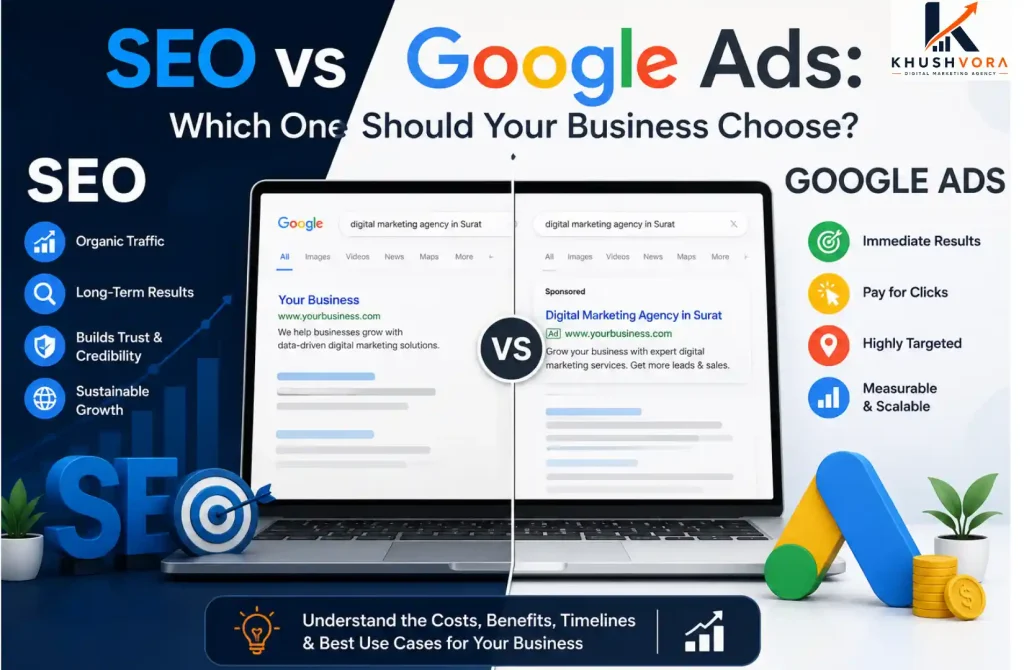
Getting your business in front of the right people on Google can happen in two main ways: organic search or paid advertising. That is where the SEO vs Google Ads debate begins. SEO helps your website earn visibility in Google’s unpaid search results. Google Ads, on the other hand, lets you pay for targeted placements when people search for terms related to your business.
Both can bring visitors, leads, and sales, but they require different approaches. SEO needs consistent optimization and patience, while Google Ads gives you more immediate control over when and where your business appears.
So, which one should you invest in?
The better option comes down to your current marketing priority. A new business looking for immediate inquiries may have different priorities from an established brand trying to build a steady flow of organic traffic.
In this guide, we’ll break down SEO vs Google Ads by looking at their costs, timelines, advantages, limitations, and ideal use cases. By the end, you’ll have a clearer idea of which approach fits your business—or whether using both makes more sense.
What Is SEO?
SEO, or Search Engine Optimization, is the practice of improving a website so that search engines can understand it better and users can find it more easily. When someone searches Google for a product, service, or answer, Google decides which pages are most relevant to that search. SEO helps your website become a stronger candidate for those organic search results.
For example, a business offering digital marketing services in Surat might optimize its service pages and helpful content around relevant searches. If those pages meet what users are looking for and perform well against Google’s ranking factors, they can gradually gain better positions.
SEO can involve several areas, such as:
- On-page SEO: Improving titles, headings, content, keywords, and internal links.
- Technical SEO: Working on site speed, mobile usability, crawling, indexing, and other technical elements.
- Off-page SEO: Building the website’s authority through relevant backlinks and online mentions.
- Content: Publishing useful information that answers questions and matches what people search for.
One important thing about SEO is that you don’t buy an organic ranking. Your position is earned through the quality and relevance of your website and content. However, SEO requires patience. A new page may need time to gain visibility, and competitive search terms can take even longer. That makes SEO particularly useful for businesses that want to build a steady source of organic traffic and online visibility over time.
What Are Google Ads?
Google Ads is Google’s paid advertising platform. It allows businesses to promote their products or services when potential customers are searching for relevant terms on Google.
For example, if someone searches for “digital marketing agency in Surat,” a business running a relevant search campaign may appear among the paid results near the top of the page. Unlike organic rankings, paid ads don’t require you to wait for a page to build search visibility. You can create a campaign, choose your targeting, set a budget, and start reaching potential customers once the campaign is approved.
Google Ads gives businesses control over several parts of a campaign, including:
- Keywords: Choose searches that are relevant to your offer.
- Location: Show ads in selected cities, regions, or countries.
- Budget: Set a daily or campaign spending limit based on your marketing goals.
- Ad copy: Test different messages and offers.
- Landing pages: Send visitors to pages designed for a specific goal.
- Conversion tracking: Measure actions such as inquiries, calls, purchases, or sign-ups.
Google Ads commonly uses a pay-per-click model for search campaigns, so advertisers may pay when someone clicks their ad. The actual cost can vary significantly based on the keyword, industry, competition, location, and other factors. The biggest advantage is speed. If your campaign is well planned, your business can start getting targeted visibility much sooner than it typically would through organic search. The trade-off is that paid visibility requires an ongoing budget. Once you stop running the campaign, you generally stop receiving traffic from those advertisements.
This is why understanding SEO vs Google Ads is important before deciding where to put your marketing budget.
SEO vs Google Ads: How They Differ
SEO and Google Ads can both bring people to your website, but the way they generate that traffic is quite different.
With SEO, you work on your website and content so Google considers your pages relevant enough to appear in organic results. With Google Ads, you pay to participate in an advertising system where your ads can appear for selected searches.
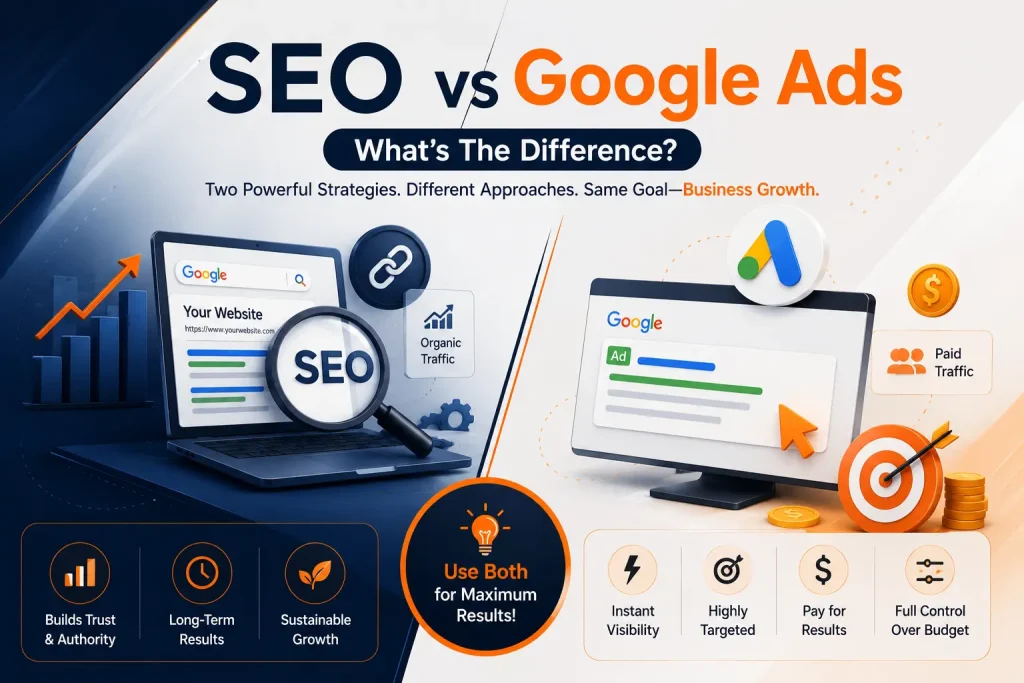
Here are the main differences:
| Factor | SEO | Google Ads |
| Traffic source | Organic search | Paid search |
| Time to visibility | It usually takes time | Can be much faster |
| Payment model | No charge for each organic click | Usually pay per click in search campaigns |
| Main investment | Content, optimization, expertise, and time | Ad budget, campaign management, and landing pages |
| Control | Less direct control over rankings | More control over targeting and budget |
| Long-term potential | Can continue producing organic traffic | Requires continued spending for paid visibility |
| Testing | Takes longer to gather data | Faster testing of keywords and offers |
| Best suited for | Sustainable organic growth | Immediate or targeted visibility |
The difference becomes easier to understand when you look at the business goal behind each channel.
If you are trying to build a website that becomes more visible over time, SEO can support that goal. If you have a specific offer and want to put it in front of people searching for it now, Google Ads may be more suitable. In many cases, the decision doesn’t have to be SEO or Google Ads. Businesses can use each channel for a different stage of their marketing strategy.
SEO vs Google Ads: Cost, Speed, and Long-Term Value
When comparing SEO and Google Ads, business owners usually care about three things: how much they need to invest, how soon they can see results, and how long those results can last.
Which One Costs More?
There is no fixed price for either channel.
With SEO, your investment may go toward content writing, website optimization, technical improvements, SEO tools, link building, or professional services. The amount depends on your website and the level of competition in your industry.
Google Ads works differently. You allocate money to your advertising campaigns, and the cost of clicks can vary depending on the keyword, location, competition, and industry. So, don’t judge SEO as “free” or Google Ads as simply “expensive.” Both require resources; they just use your budget in different ways.
Which One Gives Faster Results?
If speed is your priority, Google Ads generally has the advantage.
Once a campaign is properly set up and approved, your ads can start appearing for relevant searches. This can be useful when you need inquiries, bookings, or sales without waiting for organic rankings to develop. SEO follows a slower path. Your pages need to be discovered, evaluated, and gradually build enough relevance and authority to compete for valuable searches.
Which One Offers More Long-Term Value?
SEO can create lasting value because successful organic pages may continue attracting visitors without a separate charge for every click. Google Ads gives you more immediate access to paid traffic, but that traffic is tied to your advertising activity. If campaigns are paused, the paid visits generated by those campaigns will generally stop as well.
For this reason, many businesses use Google Ads for immediate opportunities and SEO for long-term organic growth.
When Should You Choose SEO?
SEO makes more sense when you want your website to become a reliable source of organic traffic over time.
Consider prioritizing SEO when:
- Your business is focused on long-term growth.
- Customers regularly use Google to research before buying.
- You want to build visibility around multiple related searches.
- You have useful services, products, or educational content to promote.
- You want to reduce your dependence on paid traffic in the future.
- You can invest consistently without expecting instant results.
For example, a service business can create dedicated pages for its main services and publish helpful content around customer questions. As those pages gain visibility, they can attract relevant visitors without requiring a new ad payment for every visit.
SEO is particularly valuable for businesses that want to build organic authority and sustainable search visibility. However, it requires regular work and patience, especially when competing for popular keywords. If your priority is building an online presence that can continue delivering value over the long term, SEO deserves a place in your marketing strategy.
When Should You Choose Google Ads?
Google Ads can be useful when your business needs visibility and traffic without waiting for organic rankings to develop.
It may be the better option when:
- You need inquiries or sales in the near term.
- You have a new product, service, or offer to promote.
- You want to reach people searching for specific commercial keywords.
- Your website is new and has limited organic visibility.
- You want to test a market or offer before investing heavily in content.
- You need more control over where and when your ads appear.
For example, a new local business can use search ads to reach potential customers in its target area while gradually working on its organic presence. Google Ads also makes testing easier. You can experiment with different keywords, headlines, offers, and landing pages and then use the performance data to improve your campaigns.
However, paid advertising needs proper management. A campaign can spend money without producing enough inquiries if the targeting, ad message, keywords, or landing page are poorly matched. So, SEO vs Google Ads isn’t simply about choosing the cheaper option. If immediate visibility is your main priority, paid search can be a practical starting point.
SEO vs Google Ads for Different Businesses
The right marketing channel can change depending on what you sell, who you serve, and how quickly you need customers.
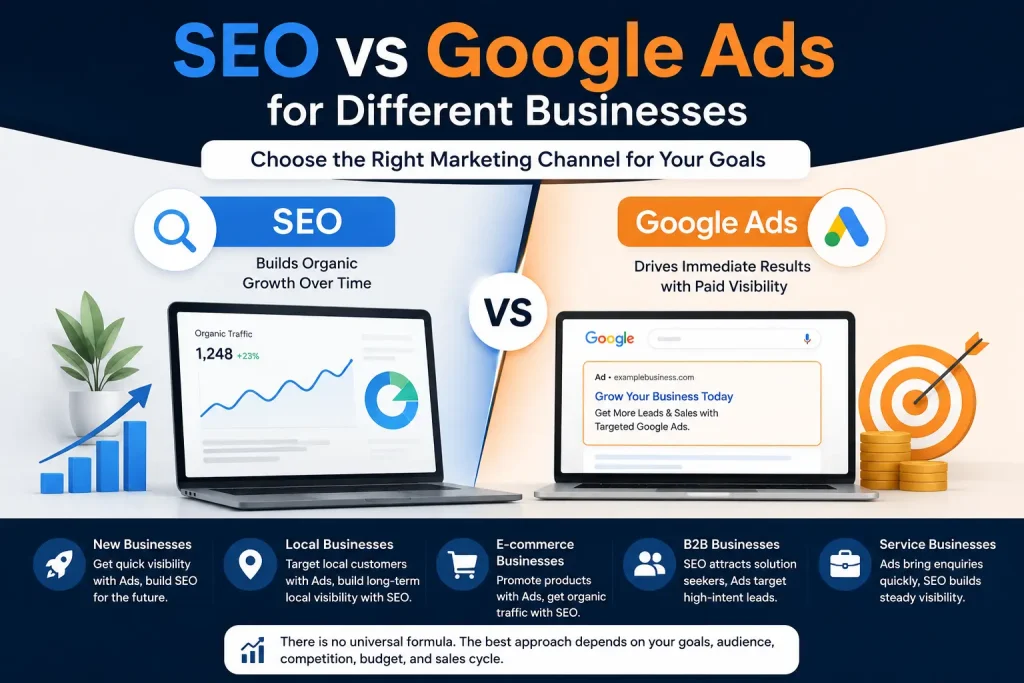
New Businesses
A new business may benefit from Google Ads for faster visibility while building its SEO foundation alongside it. This gives the business an opportunity to attract early traffic without ignoring long-term growth.
Local Businesses
For local businesses, both channels can work well. Google Ads can target searches within specific locations, while SEO can help build visibility for local searches over time.
E-commerce Businesses
E-commerce brands can use Google Ads to promote products and reach shoppers with strong buying intent. SEO can support the strategy by bringing organic traffic through product pages, category pages, and useful buying guides.
B2B Businesses
B2B companies often have longer buying journeys. SEO can help them attract people researching solutions, while Google Ads can provide targeted visibility for high-intent searches.
Service Businesses
For service-based businesses, paid search can help generate inquiries quickly, while SEO can gradually build visibility around important services and customer questions. There is no universal formula. The best approach depends on your goals, audience, competition, budget, and sales cycle.
Can You Use SEO and Google Ads Together?
Yes. Using both can give your business a more balanced search marketing strategy.
Google Ads can help you reach potential customers while your SEO efforts are still gaining traction. At the same time, SEO can gradually build organic visibility so your business does not rely only on paid traffic.
For example, you could use Google Ads to promote an important service while improving the same service page through SEO. You can also publish helpful content to attract people who are still researching before they make a decision. The two channels can also provide useful data. Google Ads can show which search terms and offers attract clicks and conversions, while SEO data can reveal what your audience searches for organically.
When comparing SEO vs Google Ads, the goal is not to spend money on both simply because they are available. Use each channel for a specific purpose, track the results, and adjust your strategy according to what is actually helping your business grow.
SEO vs Google Ads: Which One Should You Choose?
If you are still unsure about SEO vs Google Ads, start with your immediate business priority.
Choose SEO when:
- You want to build organic traffic over time.
- Your goal is long-term visibility.
- You can invest consistently without expecting instant results.
Choose Google Ads when:
- You need targeted traffic quickly.
- You have a specific offer or service to promote.
- You want greater control over your advertising budget and targeting.
Consider both when
- You need short-term visibility while building long-term organic growth.
- You want to collect advertising data while improving your website.
- Your business can support both organic and paid search efforts.
The important thing is to choose based on your business stage, budget, competition, and marketing goals rather than assuming one channel is always better. For many businesses, the strongest strategy is not about picking a permanent winner. It is about knowing where each channel fits into the customer journey and using your budget accordingly.
Conclusion
Choosing between SEO and Google Ads depends on your business goals, budget, competition, and how quickly you need results. SEO can help build long-term organic visibility, while Google Ads can provide faster traffic and targeted leads. For many businesses, the best approach is not to choose only one. Combining SEO with Google Ads can help you generate immediate visibility while building a strong organic presence for the future. The right strategy is the one that supports your business goals, reaches your target audience, and uses your marketing budget effectively.