
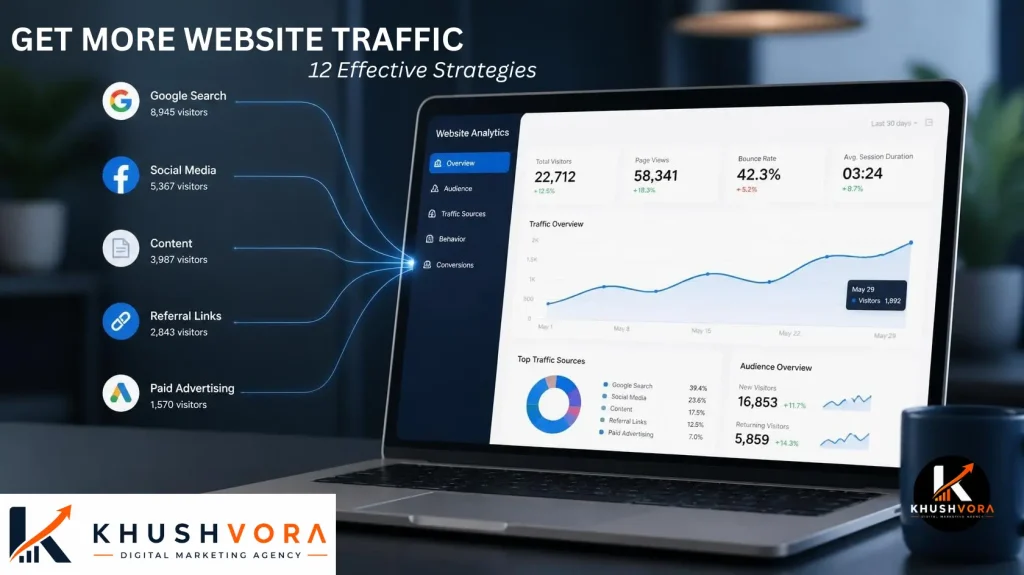
If you are wondering how to get traffic to your website, creating a website is only the beginning. You also need to make sure that the right people can find it and have a reason to visit. Website traffic can come from search engines, social media, content marketing, referrals, email, online communities, and paid advertising. But getting more visitors is not always enough. What matters is attracting people who are actually interested in your products, services, or information.
The good news is that you do not have to rely on one traffic source. A combination of organic and paid strategies can help you reach new audiences, build visibility, and bring more potential customers to your website.
In this guide, we will cover 12 effective strategies to get traffic to your website and explain how you can use them to build consistent, relevant traffic.
1. Understand Your Target Audience Before Driving Traffic
Before choosing any strategy to get traffic to your website, understand who you want to attract. Different audiences search for information in different ways, so a strategy that works for one business may not work equally well for another.
Start by identifying your ideal customers, their common problems, the questions they ask, and the platforms they use to find solutions. For example, someone looking for a digital marketing service may search Google, while another person may discover a business through Instagram, YouTube, or a recommendation.
Understanding your audience also helps you create more relevant content and choose the right traffic sources. Instead of trying to be everywhere, focus on the channels where your potential customers are most likely to spend time.
Ask yourself:
- Who are my ideal customers?
- What problems are they trying to solve?
- What keywords or questions might they search for?
- Which platforms do they use regularly?
- What type of content helps them make a decision?
Once you know your audience, it becomes much easier to attract relevant website traffic instead of simply chasing a high number of visitors.
2. Create Content That Solves Real Problems
Creating content just to publish something regularly is unlikely to bring consistent website traffic. Instead, focus on the questions, problems, and decisions your target audience is already dealing with.
For example, instead of writing a general post about digital marketing, you could answer a specific question such as how to generate leads online, how to promote a business with a limited budget, or which digital marketing channel is suitable for a particular goal.
Before creating content, take a moment to consider:
- Does it provide something useful or actionable?
- Is it easier to understand than the alternatives?
- Does it give readers a reason to explore another page on my website?
- Does this content address a real concern of my target audience?
Useful content can attract visitors through search engines, social media, referrals, and even direct recommendations. More importantly, when your content consistently solves real problems, visitors have a stronger reason to return to your website.
3. Target Long-Tail Keywords to Get More Website Traffic
Long-tail keywords are specific search phrases that usually contain more detail than broad keywords. They help you understand exactly what a person is looking for and allow you to create content that matches their search intent more closely.
For example, instead of targeting a broad phrase like “website traffic,” you could target a more specific query such as “how to get traffic to your website without paid ads.” A person searching with a detailed phrase often has a clearer problem or goal in mind.
Use relevant long-tail keywords naturally in your headings, paragraphs, page titles, and other important areas of your content. Avoid repeating the same phrase unnecessarily. The goal is to make your content useful for readers first while making it easier for search engines to understand what your page is about
4. Optimize Your Website for Search Engines
Search engines can be an important source of consistent website visitors, but your website needs to be properly optimized before expecting strong results. Start with the basics, such as writing clear page titles, useful meta descriptions, descriptive headings, optimized images, and easy-to-follow URLs.
Your content should also match the search intent behind the keywords you are targeting. If someone searches for how to get traffic to your website, the page should provide practical strategies rather than simply repeating the keyword throughout the content.
Internal linking is another useful part of SEO. Link related pages and blog posts together so visitors can discover more useful information while search engines can better understand the structure of your website.
Finally, make sure your website is mobile-friendly, easy to navigate, and technically accessible to search engines. Good SEO is not about adding keywords everywhere; it is about making your website easier for both users and search engines to understand.
5. Use Social Media to Bring Visitors to Your Website
Social media can be a useful source of website traffic when your posts give people a clear reason to visit your site. Instead of simply sharing a link, create content that catches attention and provides enough value to make users curious about the full information.
For example, you can share a useful tip on Instagram, turn a blog idea into a short video, or post an informative update on LinkedIn and direct interested users to the relevant page on your website.
Choose platforms based on where your target audience is active rather than trying to maintain a presence everywhere. Consistent, useful content can gradually increase visibility and encourage more people to visit your website.
The goal is not to collect clicks from everyone. It is to attract relevant website traffic from people who are genuinely interested in your content, products, or services.
6. Turn One Piece of Content Into Multiple Formats
One effective answer to how to get traffic to your website is to make the most of the content you already have. You do not always need to create something completely new to attract more visitors. One useful blog post can be turned into several smaller pieces of content and shared across different platforms.
For example, a detailed blog can become an Instagram carousel, a short video, a LinkedIn post, an email newsletter, or a simple infographic. Each format can reach a different part of your audience and bring interested users back to your website.
This approach saves time while giving your best content more opportunities to be discovered. Instead of publishing one piece of content and moving on, keep finding new ways to present the same useful idea.
When done consistently, content repurposing can support your content marketing strategy and help you attract more visitors without requiring you to create completely new content for every platform.
7. Build a Strong Internal Linking Strategy
Internal linking is another useful part of understanding how to get traffic to your website. By connecting related pages and blog posts within your website, you can guide visitors toward other useful information instead of letting them leave after reading just one page.
For example, if you have a blog about SEO, you can naturally link to another article about keyword research, on-page SEO, or Google Search Console. This helps visitors discover more relevant content and spend more time exploring your website.
Internal links also help search engines understand the structure and relationship between different pages on your website. A clear internal linking strategy can make your content easier to discover and help distribute SEO value across relevant pages. When adding internal links, focus on relevance and user experience rather than adding links unnecessarily. Use descriptive anchor text so visitors can understand what they will find when they click the link.
8. Get Traffic Through Google Business Profile
For local businesses, one practical way to understand how to get traffic to your website is by using a well-optimized Google Business Profile. It can help your business appear when people search for relevant products or services in your local area.
A complete profile can improve your visibility in Google Search and Google Maps. Adding your website link gives interested users a direct way to visit your website and learn more about your business, products, or services.
Keep your profile updated with accurate business information, relevant services, fresh photos, and genuine customer reviews. Regular updates can also make your business profile more useful and trustworthy to potential customers.
For businesses that serve a specific location, Google Business Profile can be an effective way to connect local searchers with your website and turn local visibility into website visits.
9. Earn Relevant Backlinks and Referral Traffic
Relevant backlinks can help your website gain more visibility and attract visitors from other trusted websites. A backlink is a link from another website to one of your pages, and links from relevant, credible sources can support your overall SEO efforts.
One way to earn backlinks is through useful guest contributions on industry-related websites. You can also create original guides, research, or helpful resources that other websites may naturally want to reference.
The goal should not be to collect as many backlinks as possible. Focus on earning links from websites that are relevant to your industry and can bring genuine referral traffic. Avoid spammy backlinks, paid link schemes, or low-quality websites created only for links, as these can harm your website’s credibility.
When you combine quality backlinks with useful content, you can improve your website’s authority while also creating additional opportunities for potential customers to discover your website.
10. Use Email Marketing to Bring Visitors Back
Getting a visitor to your website once is useful, but encouraging them to return can create more long-term value. Email marketing allows you to stay connected with people who have already shown interest in your content, products, or services.
You can send newsletters featuring new blog posts, useful resources, special offers, company updates, or other relevant content. This gives subscribers a reason to visit your website again instead of relying only on new visitors from search engines or social media.
The key is to provide useful and relevant information rather than sending emails too frequently. A consistent email strategy can help build a relationship with your audience and turn one-time visitors into returning website users.
When combined with SEO, social media, and other marketing channels, email marketing can become an effective way to bring consistent visitors back to your website.
11. Use Paid Advertising When You Need Faster Traffic
If you are exploring how to get traffic to your website and need visitors more quickly, paid advertising can be an effective option. Platforms such as Google Ads and Meta Ads allow businesses to reach specific audiences based on factors such as search intent, interests, location, and demographics.
However, paid traffic should be planned carefully. Spending money on ads without understanding your target audience, campaign goals, or expected results can lead to a wasted budget. Start with a clear objective and track important metrics such as clicks, leads, conversions, and cost per result.
Your ads should also direct users to a relevant landing page that matches the message of the advertisement. A well-designed landing page can make it easier for visitors to find the information they need and take the desired action.
Paid advertising can provide faster results than many organic strategies, but it works best when combined with long-term SEO and other sustainable traffic sources.
12. Improve Existing Pages Instead of Always Creating New Ones
When learning how to get traffic to your website, creating new content is not always the only solution. Sometimes, improving pages that already exist can help you get better results with less effort.
Start by identifying pages that receive some traffic but are not performing as well as expected. You can use Google Search Console to check impressions, clicks, search queries, and average positions. This data can help you understand which pages have opportunities for improvement.
Update outdated information, improve page titles and headings, add useful details, and make sure relevant internal links are included. You can also improve content based on the search intent behind the keywords your page is already appearing for.
Regularly reviewing and improving existing content allows you to make better use of the traffic and SEO value your website has already built instead of always starting from scratch.
How to Get Traffic to Your Website: Free vs Paid Traffic
There are several ways to drive visitors to your website, and the right approach depends on your goals, budget, audience, and timeline. Both free and paid traffic sources can play an important role in a successful digital marketing strategy.
Organic traffic comes mainly from search engines when your website ranks for relevant search queries. SEO can help generate consistent traffic over time, but it usually requires patience and regular optimization.
Social traffic comes from platforms such as Instagram, LinkedIn, Facebook, and other social networks. Sharing useful content and engaging with your audience can help bring visitors to your website without directly paying for each click.
Referral traffic comes from other websites that link to your pages. Relevant backlinks, guest contributions, and industry mentions can introduce your website to new audiences while also supporting your SEO efforts.
Paid traffic comes through advertising platforms such as Google Ads and Meta Ads. It can help you reach targeted users faster, but you need to manage your budget carefully and track campaign performance.
For most businesses, the best approach is not to depend on a single traffic source. Combining SEO, social media, referral traffic, and paid advertising according to your business goals can create a more balanced and sustainable traffic strategy.
Common Mistakes That Can Stop Your Website Traffic From Growing
Knowing how to get traffic to your website is important, but avoiding common mistakes is equally necessary. Some businesses focus heavily on increasing visitors without considering whether their strategies are actually helping the right audience find and engage with their website.
Avoid Keyword Stuffing
Using keywords naturally helps search engines understand your content, but repeating the same keyword unnecessarily can make your content difficult to read. Focus on creating useful content for people first and use relevant keywords where they genuinely fit.
Do Not Publish Random Content
Publishing content without understanding your audience or search intent can result in low-quality traffic. Choose topics that are relevant to your audience and connected to your products, services, or expertise.
Avoid Buying Spammy Backlinks
Buying low-quality or spammy backlinks just to increase your link count can put your website at risk. Instead, focus on earning relevant links from trustworthy and industry-related websites.
Do Not Depend Only on Social Media
Social media can bring valuable visitors, but relying on one platform alone can make your traffic unpredictable. Combine social media with SEO, email marketing, referral traffic, and other suitable channels.
Focus on Traffic Quality, Not Just Quantity
A large number of visitors does not always mean better results. Relevant visitors who engage with your content, contact your business, or make a purchase are often more valuable than a large number of visitors who leave immediately.
Do Not Ignore Analytics
Without tracking your website performance, it is difficult to know which traffic sources are actually working. Use tools such as Google Analytics and Google Search Console to monitor traffic, engagement, search performance, and conversions.
How to Measure Whether Your Website Traffic Is Actually Useful
Getting more visitors is not enough; you also need to know whether that traffic is helping your business. Use tools such as Google Analytics and Google Search Console to understand where your visitors come from and how they interact with your website.
Look at organic traffic, engagement, leads, conversions, and returning visitors rather than focusing only on total traffic. Check which sources bring the most relevant users and which pages generate the best results.
This data helps you identify successful strategies, improve underperforming pages, and make better decisions about where to invest your time and marketing budget.
FAQ (Frequently Asked Questions)
You can attract free website traffic through SEO, useful blog content, social media, internal linking, Google Business Profile, email marketing, and relevant backlinks. These methods usually require consistent effort rather than a direct advertising budget.
A new website can take several weeks or months to build consistent organic traffic. The timeline depends on factors such as competition, content quality, SEO, website authority, and how consistently you publish and optimize content.
There is no single best method for every business. A combination of SEO, valuable content, social media, backlinks, email marketing, and paid advertising can help attract relevant visitors from different sources.
Yes. Sharing useful content, engaging with your audience, and adding relevant website links can encourage social media users to visit your website. The results depend on your platform, audience, content quality, and consistency.